Abstract
We introduce Visual Diachronic Analysis (VDA), a new computer vision challenge for studying how the visual context of a depicted subject or theme changes over time and how these changes relate to documented historical shifts in meaning. This raises the question to what extent such changes in meaning can be inferred computationally from historical depictions. To study such phenomena, we introduce VDBench, the first benchmark for VDA. In absence of available and sufficiently annotated historical image collections, we propose an unconventional approach: we construct a historically grounded synthetic benchmark dataset. We compile a source-grounded collection of human-centred diachronic themes and design a controlled text-to-image pipeline to generate plausible synthetic historical depictions. Domain experts confirm the suitability and plausibility of the data. We specify several computer vision tasks, propose a suitable evaluation methodology, and provide baseline methods and implementations as reference for future work. The dataset and an interactive explorer are available above. All code will be released upon acceptance.
Highlights
From Lexical Drift to Visual Drift
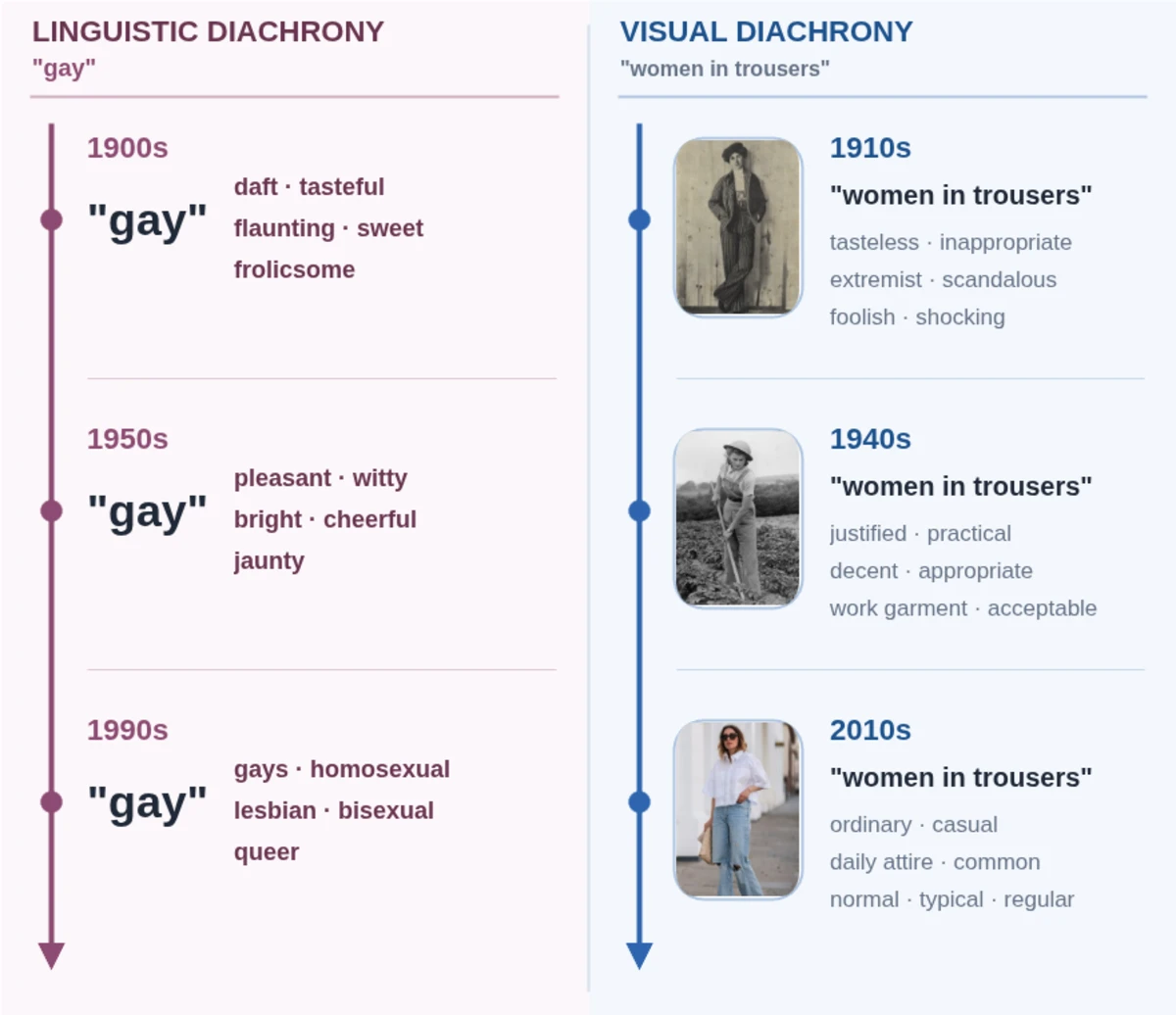
Diachronic analysis originates in linguistics: historical semantics studies how a word's meaning shifts while its form stays fixed — e.g. word-embedding neighbours of “gay” move from cheerful toward homosexual across the twentieth century. VDA asks the analogous question of images: a subject can remain visually recognisable across a century while its environment, activity, and co-occurring elements change, tracking a documented shift in social meaning.
Source-Grounded, Not Archive-Grounded
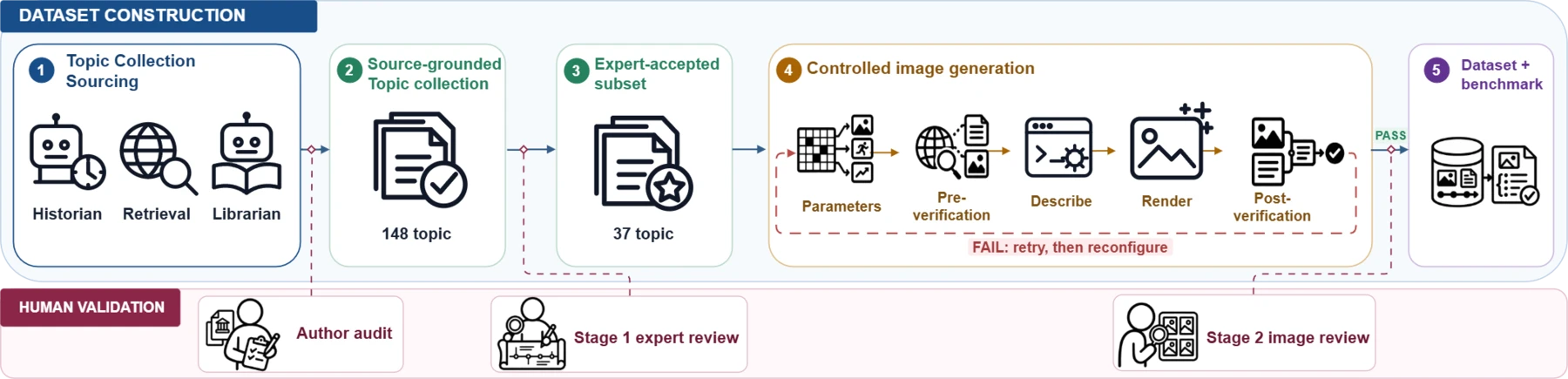
Historical archives are rarely catalogued by diachronic topic, so VDBench starts from the historical record and works forward to images. An LLM-based retrieval pipeline compiles a source-grounded collection of visual diachronic topics from scholarly literature; authors and humanities experts then filter and validate the resulting trajectories before any image is generated.
Two Benchmark Tasks
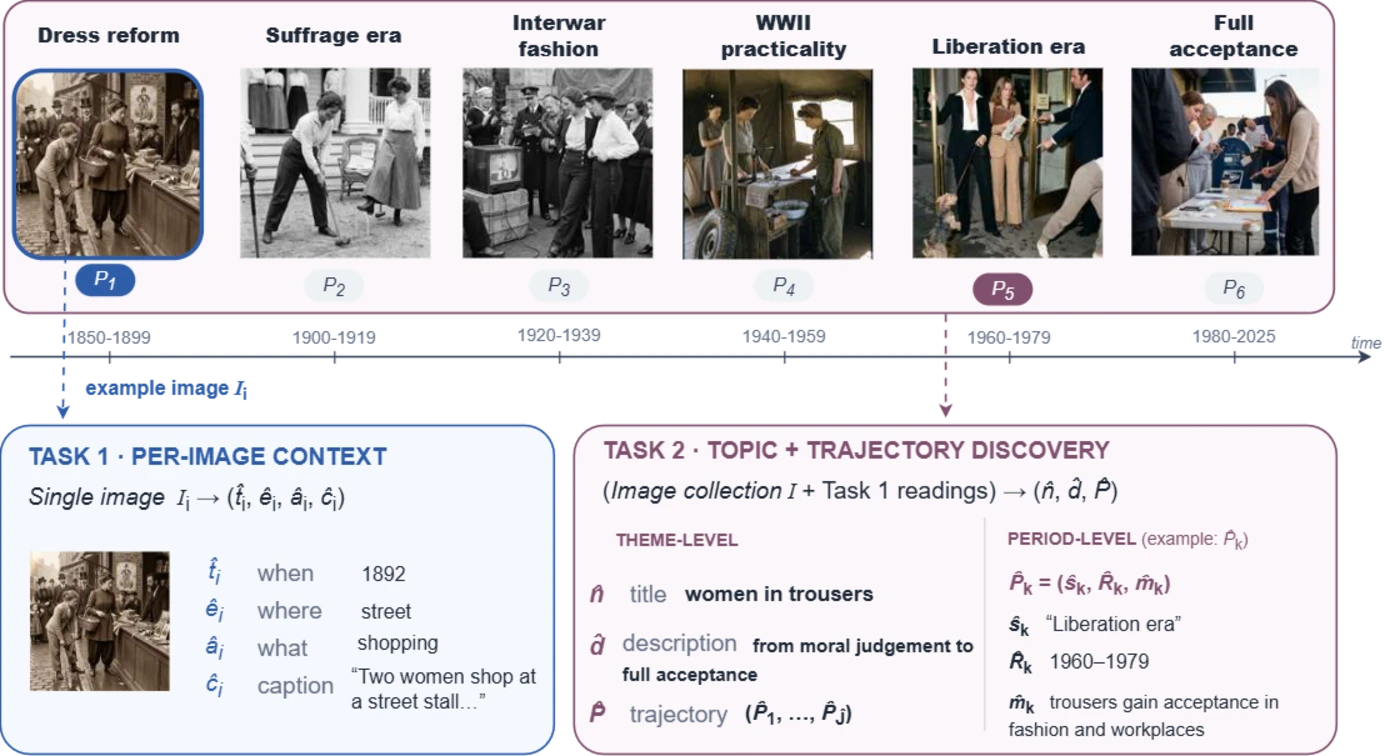
Task 1 reads the context out of a single image; Task 2 assembles many images — with either ground truth or Task-1 predictions — back into a topic's diachronic trajectory.
Task 1 · Visual context detection
- When — year the depiction is set in
- Where — environment, closed vocabulary
- What — activity, closed vocabulary
- Caption — open-vocabulary context description
Task 2 · Topic & trajectory discovery
- Partition images into J periods
- Title, year range & description per period
- Chronological ordering of the trajectory
- No Task-2 ground truth or human input provided
First Baselines, Neither Solving VDA
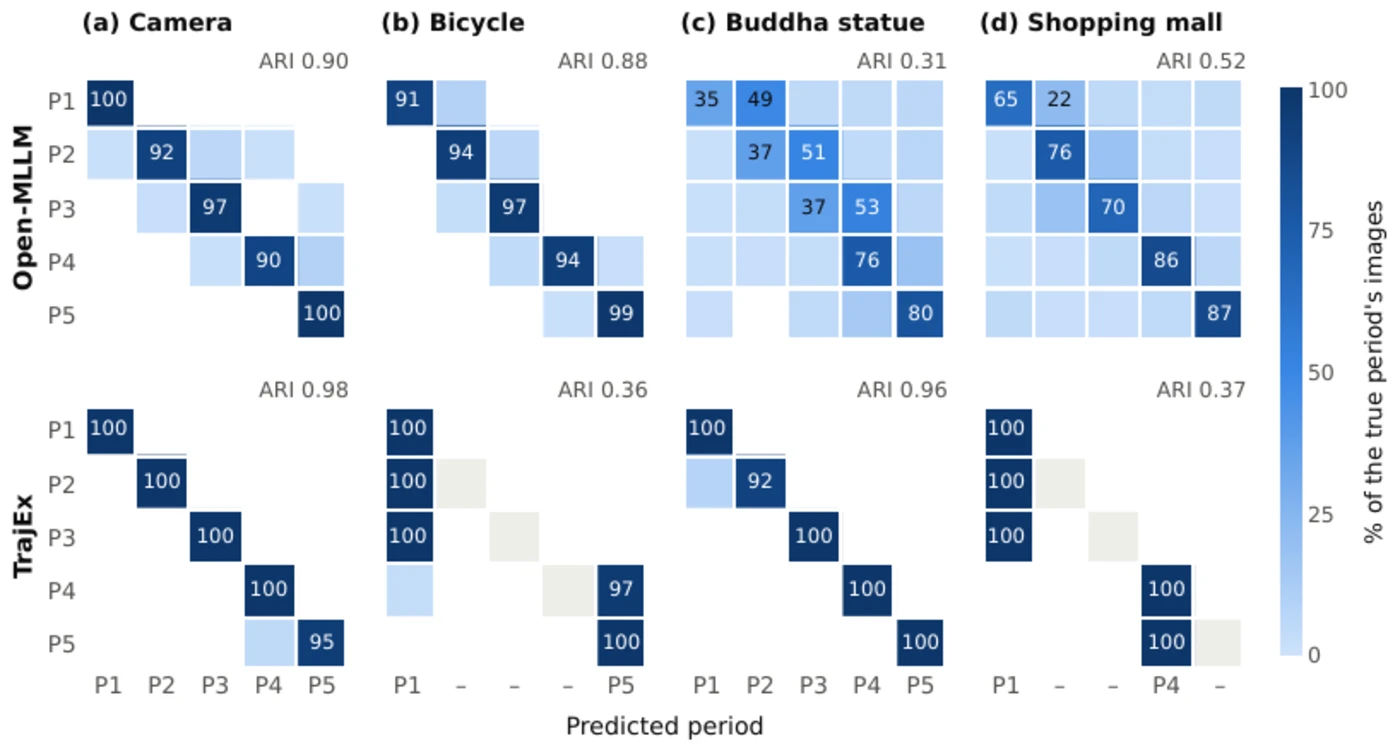
Two zero-shot, open-weight reference baselines — Open-MLLM (Qwen3-VL-32B-Instruct applied directly to both tasks) and TrajEx, a specialised pipeline combining a frozen EVA-CLIP year estimator, zero-shot environment/activity matching, and change-point detection over time — establish first reference points and expose how far current foundation models are from solving VDA.
Key Contributions
Dataset Statistics
Visual vocabularies: 669 environment classes (Places365 + SUN) · 177 activity classes (ATUS, HETUS, MTUS) · 74 dated-trend labels (Wikipedia photo categories)
Generation pipeline: GPT-5.6 Sol writes the image prompt and caption for each grounded topic/period/environment/activity combination → Nano Banana Fast renders the image → CLIP verifies the result, regenerating on failure. Two release splits are provided for supervised methods — a uniform split (every topic in train/val/test) and a topic-disjoint split (held-out topics, for generalisation). Full field-level documentation, download instructions, and split files live on the dataset page linked above.
Expert Validation
Because the benchmark is synthetic by necessity, VDBench is validated at every stage: first by the authors, then by domain experts on the historical trajectories (Stage 1), then again by experts on the rendered images (Stage 2).
Six domain experts — in gender studies, sociology, social anthropology, media and communication studies, literary studies, digital humanities, film archiving and theory, and migration history — reviewed topics within their own expertise: judging historical validity and period boundaries in Stage 1 (270 period ratings, 501 image judgements across 29 topics in Stage 2), told the images were AI-generated.
Baselines & Results
Two zero-shot, open-weight reference baselines, neither using VDBench for training, fine-tuning, or prompt selection. Open-MLLM applies Qwen3-VL-32B-Instruct directly to both tasks. TrajEx (Trajectory Explorer) is a specialised pipeline: a frozen EVA-CLIP encoder estimates the year, EVA-CLIP zero-shot matching predicts environment/activity, and change-point detection over time — refined with DINOv3 features — recovers the period structure.
| Output | Metric | Open-MLLM | TrajEx |
|---|---|---|---|
| Year | MAE (years) ↓ | 4.72 | 4.65 |
| Environment | Accuracy / macro-F1 ↑ | 0.26 / 0.21 | 0.27 / 0.26 |
| Activity | Accuracy / macro-F1 ↑ | 0.28 / 0.24 | 0.31 / 0.32 |
| Caption | BERTScore / MoverScore ↑ | 0.84 / 0.12 | 0.86 / 0.14 |
| Output | Metric | Open-MLLM | TrajEx |
|---|---|---|---|
| Image grouping | ARI / AMI ↑ | 0.56 / 0.66 | 0.79 / 0.87 |
| Period count | |Ĵ−J| ↓ | 0.63 | 1.17 |
| Period range | Temporal IoU ↑ | 0.46 | 0.63 |
| Matched order | Kendall's τ ↑ | 0.97 | 1.00 |
Limitations & Future Work
Expert validation supports the historical relevance of the compiled trajectories and the plausibility of the generated images, and the first baselines — built on state-of-the-art foundation models — show the task is far from solved. Planned extensions broaden geographic and cultural coverage, gather multiple independent expert reviews per topic, and incorporate licensed archival images where reliable annotations exist. On the methods side, promising directions include hybrid evaluation across synthetic and archival data, uncertainty-aware trajectory modelling, and text evaluation supported by multiple references and human assessment.